
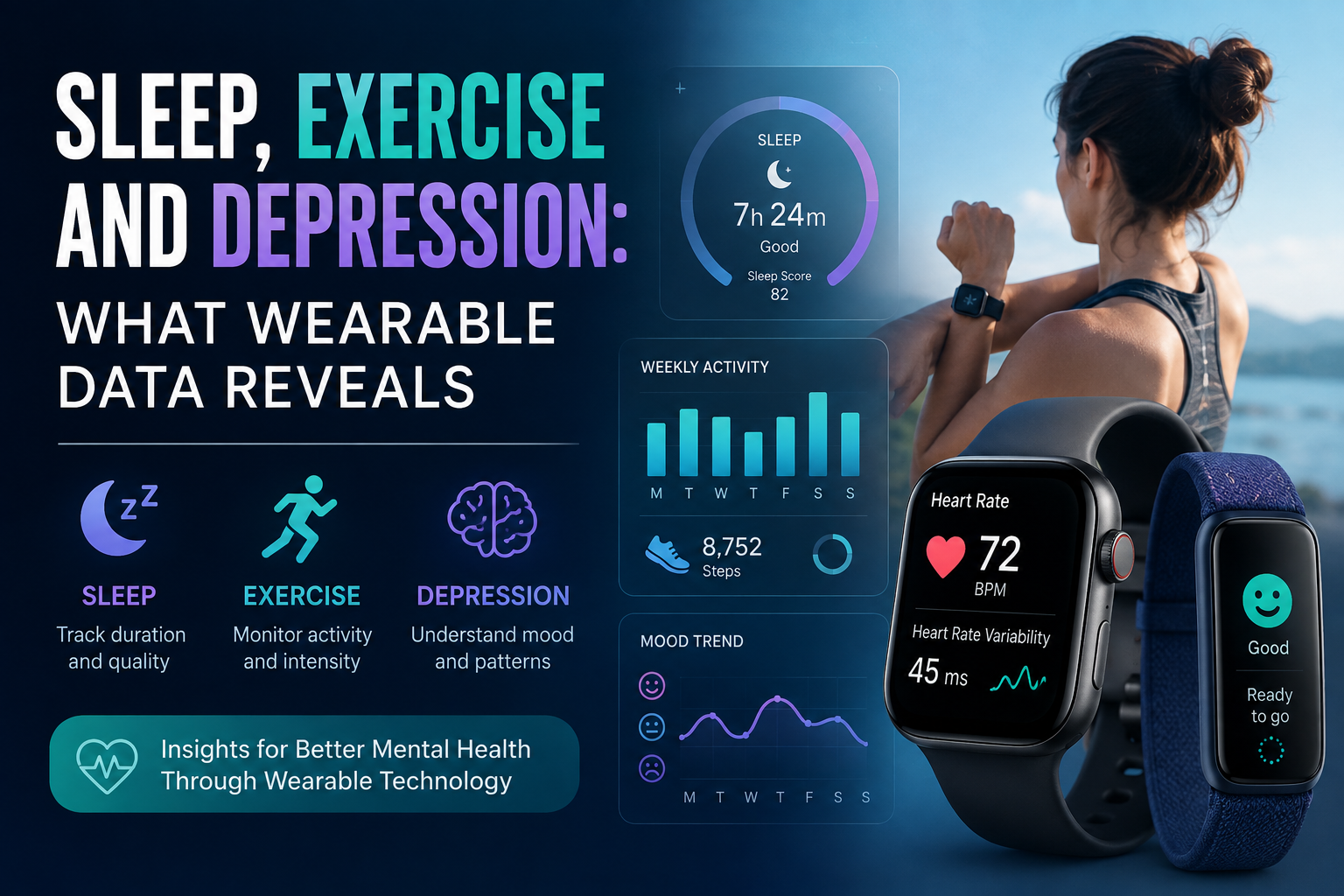
💤🏃 Sleep, Exercise and Depression: What Wearable Data Reveals


For years, researchers studying depression have depended heavily on questionnaires, interviews and clinical assessments. These tools remain essential, but a new source of information is becoming increasingly valuable: wearable technology.
Smartwatches, fitness bands and smart rings can quietly collect information about sleep, movement, heart rate and other physiological signals throughout the day and night. Instead of asking someone to remember how much they slept last Tuesday or how active they were three weeks ago, researchers can potentially examine continuous patterns recorded in everyday life.
This is particularly interesting when studying depression because depression is not limited to emotions or thoughts. It can influence sleep, physical activity, energy, daily routines and physiological responses. At the same time, disrupted sleep and inactivity may also contribute to worsening mood. The relationship is therefore complicated and often works in both directions.
Recent research has demonstrated that wearable measurements can identify meaningful patterns in sleep and activity, although important limitations remain. A longitudinal study using Fitbit data, for example, found associations between multiple sleep characteristics and depressive symptom severity. The researchers analyzed thousands of depression questionnaire records alongside wearable sleep measurements, illustrating the potential of passive data collection for mental-health research. (arXiv)
So what exactly can wearable devices tell us about sleep, exercise and depression? And could your smartwatch eventually recognize changes in mental wellbeing before you notice them yourself?
Let’s explore the science, possibilities and limitations. 🔍
🌙 1. Why Sleep Matters When Studying Depression
Sleep and mental health are deeply connected.
Almost everyone experiences an occasional poor night’s sleep. But persistent changes in sleep can be much more significant. Some people experiencing depressive symptoms struggle to fall asleep or remain asleep. Others sleep considerably longer than usual and still feel exhausted.
This creates an important scientific question:
Does poor sleep contribute to depression, or does depression disrupt sleep?
The answer is often both.
Depression can interfere with normal sleep patterns, while chronic sleep disruption may increase vulnerability to emotional difficulties. Researchers therefore increasingly view sleep as part of a complex biological and behavioral system rather than an isolated symptom.
🛌 More than simply counting hours
When people talk about sleep, they often focus on duration.
“How many hours did you sleep?”
That’s useful, but it doesn’t tell the entire story.
Wearables can potentially provide additional information, including:
- 🕐 Sleep and wake timing
- 🛌 Estimated total sleep duration
- 🌙 Periods of nighttime movement
- ❤️ Heart-rate patterns
- 📈 Changes in heart-rate variability
- 🔄 Sleep regularity
- 😴 Estimated sleep stages on supported devices
- ☀️ Differences between weekdays and weekends
Some modern wearable systems use combinations of movement and heart-rate information to estimate when a person falls asleep and wakes. (Garmin)
The important word is estimate.
A smartwatch is not equivalent to a clinical sleep laboratory. Consumer devices generally infer sleep from sensors and algorithms rather than directly measuring every physiological signal used in clinical polysomnography.
That distinction matters when interpreting the data.
📊 Why researchers like continuous sleep data
Imagine two people who both report sleeping seven hours.
Person A sleeps from 11 p.m. to 6 a.m. most nights.
Person B sleeps from 2 a.m. to 9 a.m. on Monday, 11 p.m. to 6 a.m. Tuesday, 3 a.m. to 10 a.m. Wednesday and follows another schedule on the weekend.
A basic questionnaire might record similar average sleep duration.
Continuous wearable data can reveal that their sleep regularity is very different.
That additional information may be valuable in depression research.
A study of wearable data from hundreds of young adults, for example, found that high-resolution wearable measurements could reveal regular sleep and activity patterns, including differences between school days and free days. (arXiv)
🧠 2. What Wearables May Reveal About Depressive Symptoms
Depression can affect everyday behavior.
Someone who previously went for a 30-minute walk every morning might gradually become less active. Another person may stop exercising altogether. Someone else might spend substantially more time in bed.
These changes can be difficult to remember accurately, especially when they develop gradually.
A wearable device can potentially capture them automatically.


📉 A change in activity may be more informative than a single number
Suppose a person’s typical daily movement is around 8,000 steps.
If they suddenly average 3,000 steps for several weeks, that could be an interesting behavioral signal.
But it doesn’t automatically mean depression.
Perhaps they:
- Started working from home
- Injured their leg
- Experienced extreme weather
- Took a vacation
- Became busy with exams
- Changed jobs
- Were recovering from an infection
This is why researchers are interested in patterns rather than isolated measurements.
The most useful question isn’t:
“Does this person’s smartwatch say they are inactive?”
It is:
“Has this person’s activity changed significantly compared with their normal pattern, and does that change correspond with other information about their wellbeing?”
That distinction is crucial.
🏃 3. Exercise: Another Piece of the Puzzle
Physical activity is one of the most interesting variables available from wearable devices.
Most smartwatches can record some combination of:
- 🚶 Steps
- 🏃 Walking and running
- 🚴 Cycling
- 🏋️ Exercise sessions
- ❤️ Heart rate
- 🔥 Estimated energy expenditure
- ⏱️ Exercise duration
- 📈 Workout intensity
This creates an opportunity to examine relationships between movement and mood over time.
Why exercise matters
Physical activity is associated with numerous aspects of health and wellbeing. When people exercise, they experience changes in cardiovascular function, energy expenditure, sleep patterns and other physiological processes.
But depression can make exercise difficult.
Low motivation, fatigue, reduced interest and disrupted routines can all make physical activity feel harder.
This creates a potentially important feedback loop:
Low mood → less activity → disrupted routine → poorer sleep → lower energy → potentially worse mood.
Of course, this doesn’t happen in exactly the same way for everyone.
Some people with depression remain physically active. Others may exercise intensely. Some may sleep very little, while others sleep excessively.
Depression is not a single behavioral pattern.
That’s one reason wearable research is potentially valuable: it can help researchers investigate individual differences rather than assuming everybody experiences depression in the same way.
❤️ 4. Heart Rate and Heart-Rate Variability
Sleep and movement aren’t the only signals available from wearable devices.
Many wearables also measure heart rate, while some provide estimates of heart-rate variability (HRV).
HRV describes variation in the timing between heartbeats. It is influenced by the autonomic nervous system and can change with factors such as stress, recovery, sleep and physical activity.
Researchers are interested in HRV because it may provide information about physiological regulation.
However, HRV should not be treated as a simple “depression meter.”
A lower or higher HRV reading can have many possible explanations. Training status, sleep, illness, medications, alcohol, stress and measurement conditions can all affect physiological signals.
This is a recurring theme throughout wearable mental-health research:
One metric rarely tells the whole story.
A meaningful interpretation requires context.
📱 5. From Data to Patterns
The biggest advantage of wearable technology may not be any single measurement.
It may be the ability to combine multiple measurements.
Imagine a researcher observes that over six weeks a participant has:
📉 Lower daily activity
🌙 More irregular sleep
🛌 Longer periods in bed
❤️ Changes in resting heart rate
📆 Less consistent daily routines
Individually, none of these necessarily indicates depression.
Together, however, they could represent a meaningful change from that person’s normal baseline.
Researchers can then compare these patterns with validated psychological assessments.
This is fundamentally different from saying:
“The smartwatch diagnosed depression.”
It didn’t.
Instead, the wearable provided objective behavioral and physiological information that could be studied alongside clinical information.
🔬 6. What Research Is Actually Finding
Research in this field is still developing, but several findings are particularly interesting.
A multicenter longitudinal study examined Fitbit-derived sleep data alongside depression symptom measurements. The research included data from 368 participants and more than 2,800 depression questionnaire records. The researchers extracted numerous sleep characteristics involving sleep architecture, stability, quality, insomnia and excessive sleep. Sixteen sleep features showed significant associations with depression questionnaire scores in the overall dataset, although the strength and nature of associations differed between research sites. (arXiv)
This is important because it demonstrates both the promise and complexity of wearable research.
There wasn’t one magical sleep measurement that perfectly identified depression.
Instead, multiple characteristics showed relationships with symptom severity.
That suggests depression may leave a subtle behavioral “fingerprint” rather than a single obvious digital signal.
🧪 New approaches are also improving sleep tracking
Researchers are continuing to develop methods for extracting sleep information from raw wearable sensor data.
A 2026 study described a lightweight sleep-tracking pipeline using accelerometer signals and evaluated it across wearable platforms. The work highlights ongoing efforts to make sleep measurement more reproducible and less dependent on proprietary algorithms. (arXiv)
This matters because different wearable companies use different sensors, algorithms and definitions.
If two devices produce different sleep estimates, researchers need reliable methods for understanding those differences.
📈 7. Why Long-Term Trends Are More Useful Than Daily Scores
One of the biggest mistakes people can make with wearable technology is becoming obsessed with individual numbers.
Suppose your smartwatch gives you a sleep score of 72 one morning.
Is that bad?
Not necessarily.
Maybe you had one late night.
Perhaps the sensor wasn’t worn correctly.
Maybe you were traveling.
Maybe the algorithm simply estimated your sleep differently.
A single number has limited meaning.
Long-term trends can be much more informative.
Research and clinical commentary increasingly emphasize looking at patterns over time rather than interpreting isolated wearable scores.
For example:
One night of poor sleep: probably not particularly informative.
Three months of progressively irregular sleep combined with declining activity: potentially much more interesting.
This principle applies to mental health as well as physical health.
🧩 8. The Importance of Personal Baselines
Everyone has a different normal.
One person may naturally sleep seven hours.
Another may routinely sleep eight or nine.
One person’s resting heart rate may be relatively low.
Another person’s baseline may be higher.
One individual may walk 12,000 steps daily.
Another may normally walk 4,000.
Therefore, wearable research increasingly benefits from establishing an individual’s baseline.
Instead of asking:
“Is 6,000 steps unhealthy?”
researchers can ask:
“Is 6,000 steps significantly different from this person’s usual activity?”
That’s a much more useful question.
A personalized baseline can potentially make digital health systems more sensitive to meaningful changes while reducing false alarms.
🤖 9. Artificial Intelligence Could Change Wearable Mental-Health Research
Artificial intelligence is becoming increasingly important in wearable analytics.
Machine-learning systems can examine enormous quantities of sensor data and search for combinations that humans might not easily identify.
A future system might analyze:
Sleep + activity + heart rate + HRV + movement + routine + self-reported mood
rather than looking at each variable separately.
Researchers have already explored wearable-enabled machine-learning approaches for stress monitoring. In one 12-week study involving college students, a smartwatch-based intervention was associated with reductions in an objective measure of stress moments, although the study did not demonstrate significant between-group differences in depression questionnaire scores.
That finding provides an important lesson.
AI and wearable technology may be useful, but success in detecting or managing one aspect of mental wellbeing does not automatically mean the technology can diagnose or treat depression.
The science needs to be evaluated separately for each condition and outcome.
🔐 10. Privacy: The Hidden Issue Behind Wearable Mental-Health Data
There’s another side to all this technology.
Your smartwatch can collect extremely personal information.
Think about what continuous monitoring could reveal:
🕐 When you sleep
🏃 When you exercise
❤️ Your physiological patterns
📍 Potentially where you travel
📱 How frequently you interact with your phone
📊 Changes in your daily routine
When these data are combined with mental-health information, they become particularly sensitive.
This raises important questions:
- Who owns the data?
- Who can access it?
- How long is it stored?
- Is it shared with third parties?
- Can researchers use it anonymously?
- Could employers or insurers access it?
- How securely is it protected?
Privacy should not be treated as an afterthought.
The more detailed wearable technology becomes, the more important responsible data governance becomes.
⚠️ 11. Wearables Are Not Depression Diagnostic Devices
This is perhaps the most important point in the entire discussion.
A smartwatch cannot currently replace a qualified mental-health professional.
A low sleep score does not mean you have depression.
A high stress score does not mean you have an anxiety disorder.
A decline in steps does not prove that you are experiencing a depressive episode.
And a “good” wearable score does not prove that your mental health is fine.
Wearable measurements are influenced by countless factors.
For example:
Poor sleep could result from:
- Stress
- Caffeine
- Travel
- Noise
- Illness
- Shift work
- Parenting
- Alcohol
- Medication
- An uncomfortable environment
Low activity could result from:
- Work
- Injury
- Weather
- Recovery
- Lifestyle changes
- Travel
- Physical illness
Consequently, wearable data should be interpreted as supporting information, not a diagnosis.
😰 12. Can Wearables Actually Make People More Anxious?
Ironically, technology designed to improve health can sometimes create additional worry.
Imagine waking up and immediately checking:
“How was my sleep?”
Then seeing a low score.
You might feel fine—but suddenly you’re worried that your body didn’t recover properly.
Later, your stress score rises.
You begin checking your heart rate.
Then your activity score falls.
Eventually, you may spend more time monitoring your health than actually living your life.
This phenomenon is worth taking seriously.
Experts have noted that wearable data can be useful for identifying long-term trends, but excessive attachment to scores and alerts may increase anxiety for some users.
The goal should be:
Use the data as a tool—not as a judgment.
🌙 13. How to Use Sleep Data More Wisely
If you use a smartwatch or fitness tracker, focus on trends.
Instead of asking:
❌ “Why was my sleep score 68?”
Try asking:
✅ “Has my sleep schedule become more consistent over the past month?”
Instead of:
❌ “Did I get enough deep sleep last night?”
Try:
✅ “Am I consistently getting enough sleep and waking up feeling rested?”
Instead of:
❌ “My watch says I slept badly, so today will be terrible.”
Try:
✅ “I slept differently last night. How do I actually feel today?”
Your subjective experience still matters.
Wearable data should complement your experience, not override it.
🏃 14. Using Exercise Data Without Becoming Obsessed
The same approach applies to exercise.
Don’t think only about hitting a perfect step count.
Look for sustainable patterns.
For example:
🚶 Take regular walks
🏋️ Include appropriate strength training
🚴 Choose activities you enjoy
🧘 Include recovery days
😴 Prioritize adequate sleep
🌳 Spend time outdoors when possible
If your wearable shows that you have become less active, treat that as an invitation to reflect rather than a reason to feel guilty.
Ask yourself:
“What changed?”
Maybe you’re stressed.
Maybe your schedule changed.
Maybe you aren’t sleeping well.
Maybe you’ve simply been busy.
Understanding the reason is more useful than criticizing the number.
🧠 15. The Future: Could Wearables Detect Mental-Health Changes Earlier?
This is where the field becomes particularly exciting.
Imagine a future system that learns your normal behavioral patterns over several months.
It knows:
- Your typical bedtime
- Your normal waking time
- Your average activity
- Your normal resting heart rate
- Your usual exercise routine
- Your typical physiological patterns
Then it detects a sustained change.
Instead of saying:
“You have depression.”
the system might say:
“Your recent sleep and activity patterns differ significantly from your usual baseline.”
That could encourage a person to pause and reflect.
Perhaps they are simply overworked.
Perhaps they need more rest.
Perhaps they are experiencing stress.
Or perhaps they recognize that their mood has been declining and decide to speak with a healthcare professional.
That is a much more realistic and responsible role for wearable technology.
👩⚕️ 16. Wearables Could Support Clinicians—Not Replace Them
Healthcare professionals often rely on information collected during appointments.
But a 20-minute appointment provides only a snapshot.
Wearables could potentially provide a longer behavioral timeline.
Imagine a clinician being able to see that a patient experienced:
📉 A gradual reduction in activity
🌙 Increasingly irregular sleep
⏰ Changes in daily timing
❤️ Physiological changes
📆 Several weeks of behavioral disruption
Combined with conversations and validated assessments, this information could potentially give clinicians additional context.
But this requires careful validation.
A healthcare system cannot simply take a consumer smartwatch score and treat it as a clinical measurement.
The technology must be tested across different populations, ages, lifestyles and health conditions.
🌍 17. Why Diversity Matters in Wearable Research
Another important issue is representation.
A wearable algorithm trained primarily on one population may not perform equally well for everyone.
Researchers need data from people with different:
- Ages
- Genders
- Body types
- Activity patterns
- Sleep schedules
- Cultural backgrounds
- Health conditions
- Work patterns
This is particularly important in mental-health research because depression can appear differently across individuals.
A system designed around a single behavioral pattern could miss people whose symptoms look different.
Better datasets and transparent validation will therefore be essential.
📊 18. The Three-Layer Model: Sleep + Exercise + Mood
One useful way to understand this entire field is to think about three interconnected layers.
🌙 Layer 1: Sleep
Researchers can examine:
- Duration
- Timing
- Regularity
- Nighttime movement
- Estimated sleep stages
🏃 Layer 2: Activity
They can examine:
- Steps
- Exercise
- Sedentary time
- Movement patterns
- Activity intensity
🧠 Layer 3: Mental wellbeing
This can include:
- Mood questionnaires
- Depression symptom scales
- Stress assessments
- Clinical interviews
- Self-reported wellbeing
The most meaningful research happens when these layers are studied together.
For example:
Sleep becomes irregular → activity decreases → mood scores worsen.
Or perhaps:
Mood improves → activity increases → sleep becomes more regular.
These patterns could help researchers better understand the relationship between behavior and mental health.
🔮 19. What the Next Generation of Wearables Might Do
Wearable technology is moving beyond simple step counting.
Modern devices increasingly offer sleep analysis, stress-related measurements, heart-rate monitoring, recovery scores and exercise insights. Current consumer devices demonstrate how many different health signals can already be collected from the wrist. (Garmin)
Future systems may combine these signals with:
🤖 Artificial intelligence
☁️ Cloud-based analytics
📱 Smartphone-based mood tracking
🧠 Digital mental-health tools
🩺 Clinical health records
🎙️ Voice and behavioral analysis
The objective should not be to create a machine that “reads your mind.”
A more realistic goal is to create technology capable of recognizing meaningful changes in behavior and physiology and presenting them in a useful, understandable and privacy-conscious way.
💡 20. Five Things Wearable Data Can Teach Us
After looking at the research, five broad lessons stand out.
1️⃣ Trends are more important than individual scores
One bad night doesn’t define your health.
2️⃣ Sleep and activity are interconnected
Changes in one can influence the other, while both may relate to mood.
3️⃣ Personal baselines matter
Your normal pattern may be more informative than a generic target.
4️⃣ Wearables provide clues, not diagnoses
Clinical assessment remains essential.
5️⃣ Mental-health data requires strong privacy protection
The more personal the data becomes, the more carefully it needs to be protected.
🌟 Conclusion: A New Window Into Mental Health
Wearable technology is opening a fascinating new window into the relationship between sleep, exercise and depression.
For researchers, continuous data can provide something traditional questionnaires cannot: a detailed view of everyday behavior. Sleep patterns can be observed over weeks and months. Activity levels can be measured throughout the day. Heart-rate and other physiological signals can add another layer of information.
Research has already shown that wearable-derived sleep characteristics can be associated with depressive symptom severity, while other studies demonstrate the ability of wearable devices to capture detailed patterns of sleep and physical activity.
But technology should be approached with realism.
A smartwatch cannot look at your wrist and determine whether you have depression. Algorithms can make mistakes. Sleep-stage estimates are not equivalent to clinical sleep testing. Activity changes can have dozens of explanations. And constantly monitoring health scores can sometimes create anxiety rather than reduce it.
The real opportunity lies in combining wearable data + personal experience + validated psychological assessments + professional healthcare.
In the future, a wearable might not tell us exactly what is happening inside someone’s mind. But it could help reveal when their everyday patterns have changed.
And sometimes, recognizing that change may be the first step toward asking an important question:
“How am I really doing?” 💙
When used thoughtfully, wearable technology could become more than a fitness gadget. It could become a valuable research tool—and potentially an additional support for understanding the complex relationship between sleep, physical activity and mental wellbeing.