
Food Waste to Superfood: Can Fruit Peels Become Nutritious Ingredients?
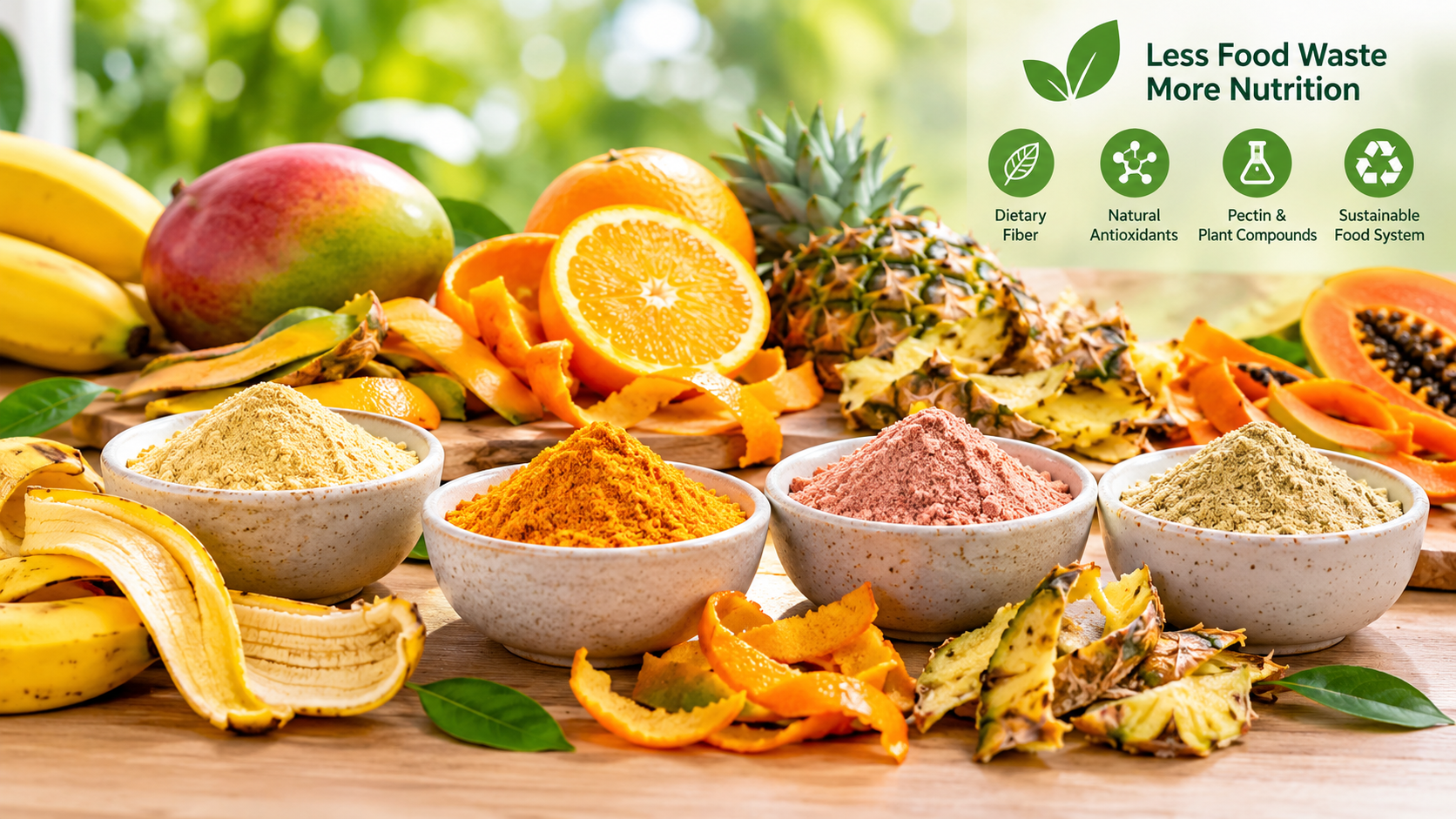
Fruit peels are often thrown away during food preparation, juice production, and food manufacturing. However, many of these discarded materials contain dietary fiber, natural plant compounds, and minerals that could be recovered and used in new food products. 🍊🌱
Researchers are exploring how fruit-processing by-products can become useful ingredients in breads, biscuits, breakfast cereals, smoothies, snacks, and other foods. This emerging field connects nutrition science, food technology, and environmental sustainability.
The important question is not simply whether fruit peels contain nutrients, but whether they can be processed into safe, nutritious, affordable, and appealing food ingredients.


6
The Science Behind Turning Fruit Peels Into Food
Food scientists call this process food by-product valorization or upcycling. Instead of treating fruit-processing leftovers as waste, they investigate whether useful components can be recovered and converted into ingredients with nutritional or technological value.
A review published in 2025 in Sustainable Food Technology examined the potential of tropical fruit peels, including mango, banana, dragon fruit, pineapple, and papaya, as sources of antioxidants and functional food ingredients. The research also highlights the importance of testing how well these compounds survive processing and digestion.
This is part of a broader movement toward a circular food system, where resources are used more efficiently and fewer valuable materials are discarded.
Which Fruit Peels Could Become Nutritious Ingredients?

Banana peels 🍌
Banana peels contain dietary fiber, pectin, resistant starch and various plant compounds. Researchers are investigating banana peel powder in baked foods, flour blends and other products. A 2026 review describes promising food applications, while emphasizing that composition, processing and sensory quality vary.

Mango peels 🥭
Mango peels contain dietary fiber and polyphenols, including compounds studied for antioxidant activity. Researchers are exploring their use in biscuits, food powders and extracts. However, the amount and type of useful compounds depend on the mango variety, ripeness and processing method.

Orange and lemon peels 🍊
Citrus peels are promising sources of pectin, fiber and flavonoids. Pectin is particularly useful because it can thicken foods and help form gels. Potential applications include marmalades, bakery products and selected food formulations.

Pineapple and papaya peels 🍍
These peels are being investigated for fiber, phenolic compounds and other potentially useful substances. Depending on the source and processing method, their components may be suitable for food ingredients, extracts or other applications. More testing is needed before assuming that every preparation is suitable for eating.
What Nutrients Can Fruit Peels Provide?
Dietary fiber for digestive health
One of the most promising properties of fruit peels is their fiber content. Dietary fiber supports normal bowel function, and certain types can be fermented by gut microorganisms.
Pectin, a soluble fiber found in many fruits, is particularly interesting because it can influence food texture and may contribute to the physiological effects of fiber-rich diets.
However, the benefits of a peel-based ingredient depend on the amount consumed, its composition and how it is processed. A product containing a small quantity of peel powder may provide less fiber than its marketing suggests.
Polyphenols and antioxidant activity
Fruit peels can contain polyphenols, flavonoids and other plant compounds that researchers study for their antioxidant properties.
In laboratory experiments, some of these compounds can neutralize reactive molecules under specific conditions. But laboratory antioxidant activity does not automatically demonstrate that eating the ingredient prevents disease or improves health in humans.
Scientists must also determine whether the compounds remain stable during drying, milling, baking and digestion, and whether the human body can absorb or use them.
Pectin and functional food properties
Pectin is valuable beyond its nutritional role. Food manufacturers use it as a thickener, stabilizer and gelling agent.
Recovering pectin from citrus peels, for example, could help replace some commercially sourced ingredients while creating value from materials that might otherwise be discarded.
This demonstrates an important point: an upcycled ingredient can be useful because it improves food quality, even when its direct health benefits have not yet been established.
How Does Food Waste Become a Food Ingredient?


Transforming fruit peels into food ingredients requires more than collecting and grinding discarded material. The process must protect food safety while preserving desirable nutritional and functional properties.
- Collection and sorting: Food-grade peels are collected from traceable sources. Rotten, moldy or otherwise unsuitable material is rejected.
- Cleaning and preparation: The material is cleaned using a validated process to remove soil and other contaminants. Washing alone cannot guarantee the removal of all pesticide residues or chemical hazards.
- Controlled drying: Moisture is reduced under appropriate conditions to limit microbial growth and improve storage stability. The correct time and temperature depend on the fruit and intended ingredient.
- Grinding and processing: The dried peels may be milled into powder or processed to recover particular compounds, such as pectin or polyphenols.
- Quality and safety testing: The final ingredient is assessed for relevant microbial hazards, chemical contaminants, nutritional composition and consistency.
- Food product development: Scientists test the ingredient in products such as bread, crackers, biscuits or cereals, evaluating taste, texture, shelf life and consumer acceptance.
A 2025 review of fruit by-product safety emphasizes that contamination risks vary with the raw material and processing conditions. A method that works for one fruit cannot automatically be assumed to work for another.
Could Fruit Peel Powder Make Everyday Foods Healthier?
The idea becomes particularly interesting when fruit peel ingredients are incorporated into familiar foods rather than marketed as expensive supplements.

Bread and bakery products 🍞
Carefully formulated peel powders could increase the fiber content of some baked foods. Researchers must balance the amount added with the effects on dough structure, flavor, color and softness.

Biscuits and crackers 🍪
Small quantities of fruit-derived powders may provide fiber and alter texture. Excessive inclusion can make products bitter, darker or less appealing, depending on the fruit.

Yogurt and breakfast foods 🥣
Selected food-grade fiber ingredients or extracts may be incorporated into suitable formulations. Their effects on acidity, texture, stability and flavor need to be evaluated.
Research supports the feasibility of some of these applications, but the outcome depends on the ingredient and recipe. More peel powder does not necessarily mean a healthier or better-tasting product.
The Biggest Challenge: Is Fruit Peel Food Safe?

This is the most important question in fruit-peel upcycling.
A peel may come from an edible fruit, but that does not mean it is automatically safe to consume in concentrated or powdered form. The surface of fruit can encounter pesticide residues, environmental contaminants, dirt and microorganisms during cultivation, transport and handling.
Research reviews have identified several hazards that may require assessment, including:
- Pesticide and fungicide residues: These can remain on certain fruit surfaces.
- Heavy metals: Lead, cadmium and other contaminants may enter agricultural materials from environmental sources.
- Mold and mycotoxins: Poor handling or storage can allow mold growth and create additional hazards.
- Naturally occurring compounds: Some plant materials contain compounds that require specific safety assessment.
- Microbial contamination: Wet processing residues can spoil quickly if not handled and stored appropriately.
These risks differ by fruit and source; they do not mean every fruit peel is dangerous. They mean that food manufacturers must verify safety rather than assume it.
Can washing and drying solve the problem?
Not entirely. Washing may remove some surface dirt and residues, while appropriate drying and other validated treatments can control particular microbial risks. However, neither method guarantees that every chemical contaminant or naturally occurring hazard has been eliminated.
Commercial ingredients therefore require suitable sourcing, traceability, process validation and testing. Products intended for sale in India must also comply with applicable food safety requirements.
Practical advice: Do not use moldy peels, spoiled fruit scraps or unknown industrial processing waste to make food. For home cooking, use fresh fruit from a reliable source and only use the peel of a fruit that is suitable for the intended culinary purpose. Thoroughly wash it under running water, and follow appropriate preparation guidance. Washing does not make every peel or every preparation safe to eat.
What Does This Mean for India?
India has a particularly interesting opportunity to explore fruit-peel upcycling because of its large fruit production and diverse food-processing sector.


8
Mango, banana, citrus fruits and pineapple are used in homes, markets, juice shops and food-processing businesses. Their peels and other by-products may represent potential raw materials for food ingredients and other valuable products.
For example, a fruit-processing facility could investigate whether clean mango peel collected during production can be converted into a standardized fiber-rich powder. A citrus processor might evaluate pectin recovery from orange peels. A banana processor could study whether banana peel powder is suitable for a particular baked product.
These examples describe potential applications, not proof that every facility can implement them economically. Each project would need to evaluate the availability of consistent raw materials, collection and drying costs, energy use, contamination controls, processing efficiency and consumer demand.
Small businesses and food entrepreneurs could eventually benefit from this approach if they can turn a low-value by-product into a safe ingredient at a competitive price.
Nevertheless, animal feed, composting, biogas production and other non-food uses may remain more appropriate for certain by-products. The best solution depends on food safety, local needs and environmental impact.
Can Fruit Peels Really Become a Superfood?
The word superfood is often used in marketing, but it is not a scientific guarantee of exceptional health benefits.
Fruit peels may offer useful fiber, pectin and plant compounds. They can also help reduce waste and create new commercial opportunities. However, a concentrated powder is not automatically more nutritious than eating whole fruit, and laboratory findings should not be confused with proven clinical benefits.
Scientists need to evaluate several questions before a peel-derived ingredient can be considered a reliable nutritional innovation:
- Does it contain meaningful amounts of useful nutrients?
- Are those nutrients available to the body after digestion?
- Is the ingredient safe at the proposed level of consumption?
- Does it retain its properties during food processing and storage?
- Do people enjoy eating the resulting product?
- Does its production actually reduce environmental impacts compared with alternative uses?
Research into food by-product valorization is progressing, but these questions must be answered for each ingredient and intended application.
Conclusion: From Discarded Peels to Sustainable Nutrition
Food waste to superfood is a promising research direction at the intersection of nutrition, food technology and environmental sustainability. Fruit peels that were once discarded may become sources of dietary fiber, pectin and other valuable compounds, with potential applications in bakery products, breakfast foods and specialized food ingredients.
The greatest opportunity lies in combining nutritional science with responsible manufacturing. Safe sourcing, appropriate processing, contaminant testing and evidence-based health claims must come before marketing.
For consumers, the message is simple: reducing food waste is worthwhile, but not every discarded part of a fruit should be eaten. For researchers and food businesses, the challenge is to identify which by-products can be transformed into genuinely useful products without compromising safety, affordability or taste.
The future of sustainable food may depend not only on what we grow, but also on how intelligently we use what we already produce. 🌱
